Verdict
For the right listener in the right room, the SC-CX700 is an impressive, well-executed all-in-one solution. Just understand what they do brilliantly—and what they don't—before you buy.
The Good
- Great midrange and upper clarity
- Solid connection options
- Auto room correction
- Front bass ports
The Bad
- Limited bass extension
- Premium pricing
- Basic EQ controls
Disclosure: Technics sent these speakers to review, but they did not sponsor this article nor did they have any input into what was written. Opinions in this article are honest, and my own.
A Premium All-in-One Speaker That Nearly Does It All
I’ve been testing the Technics SC-CX700 speakers for the last month, and they’ve impressed me more than I expected. These aren’t just another set of powered speakers. They combine 200 watts of built-in power, wireless streaming, a built-in phono stage for turntables, TV connectivity, and auto room correction ability — all wrapped up in a premium microfiber exterior. At $2,999 USD / £2,399 / $4,699 AUD for the pair, they’re positioned to compete directly with speakers like the award-winning KEF LS50 Wireless II. There’s certainly a few things to talk about before you rush out and buy them though…
Design and Build Quality
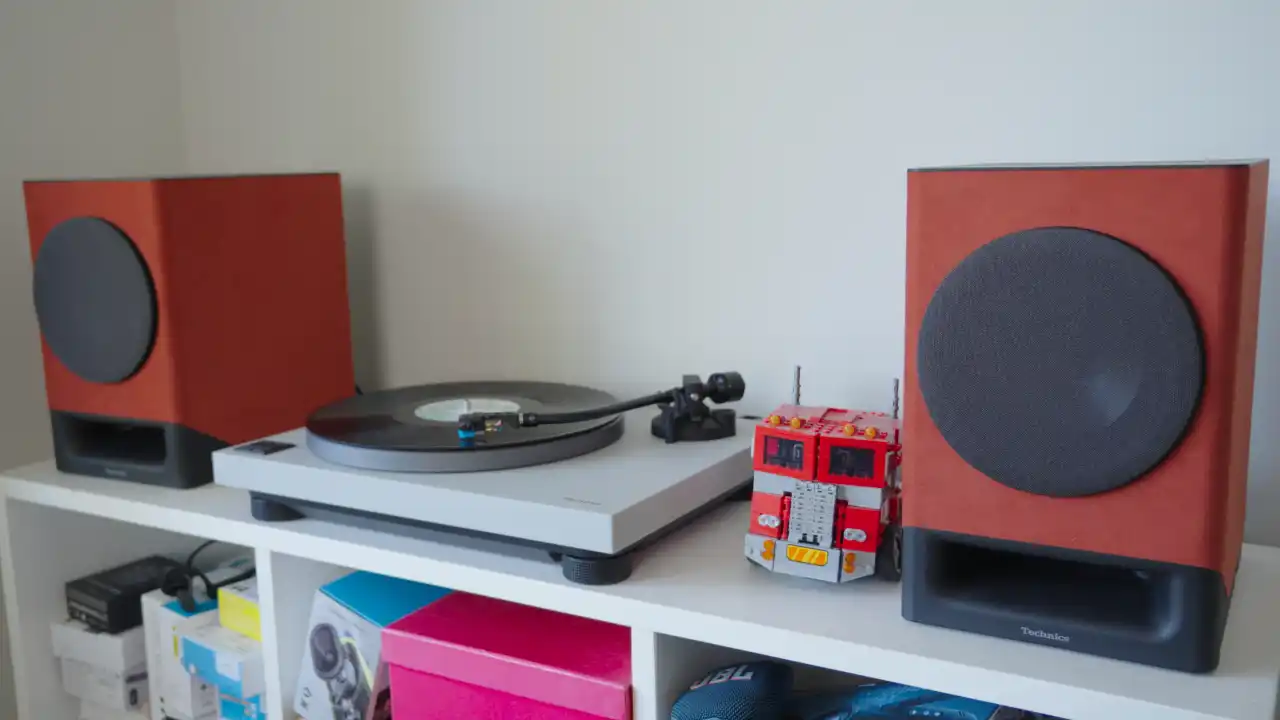
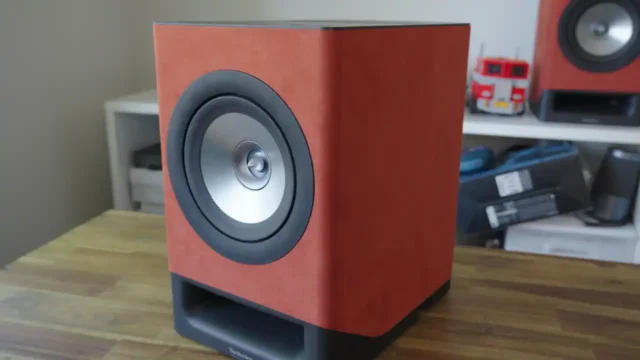
Technics certainly aren’t following typical convention when it comes to the design of the CX700 speakers as instead of wood veneer or paint, they’re covered in Dinamica microfiber—a suede-like material commonly found in luxury car interiors. The texture makes these speakers surprisingly tactile. You’ll want to touch them.
The terracotta brown version I tested reads more as burnt orange. You can also get them in charcoal black or silky gray. These color options match Technics’ recent turntables like the SL-40CBT, so you can coordinate your setup. In a market flooded with black boxes, it’s refreshing to see something different.
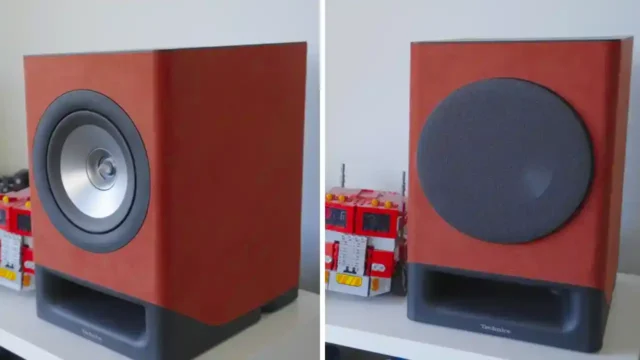
The CX700’s are compact, considering what’s packed inside them, at 8 inches wide, 12 inches tall, and weighing 21 pounds (primary) and 18 pounds (secondary). That heft comes from solid MDF construction designed to minimize resonances. Optional magnetic grills also attach securely to cover each speaker so it’s an easy personal choice as to whether you use them or not – Personally I think they look better without them. Build quality is nothing short of excellent and reflects both Technics heritage and the speakers premium price point.
What Makes Them Different
Technics has designed each speaker with a coaxial driver configuration—a three-quarter inch tweeter sitting in the middle of a 6-inch woofer. This allows both the high and low frequencies to come from the same physical point giving you better phase coherence and more accurate sound staging. You can better tell where instruments are positioned in a recording.
Each speaker also has a forward-facing bass port. Unlike rear-ported speakers that need space from walls, these can sit closer to boundaries without booming or muddiness. Inside, a solid wall separates the driver chamber from the amplification electronics, further reducing interference and adding cabinet rigidity.
Connectivity: Wired and Wireless
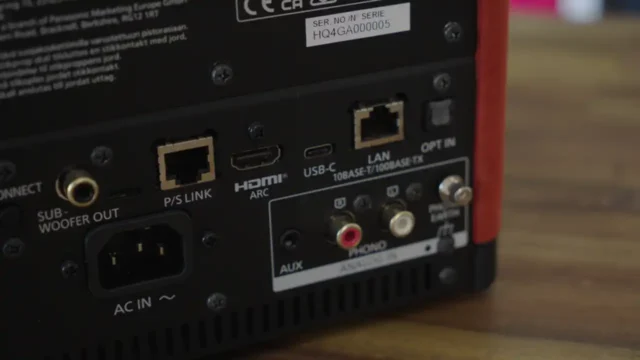
This is where the SC-CX700 really shines. All connections go to the primary speaker, and there are a lot of them.
Analog inputs include dedicated phono inputs with a built-in preamp that allows you to connect your turntable directly, and a 3.5mm auxiliary jack.
Digital inputs include optical (e.g. for CD players) and USB-C supporting up to 24-bit/192kHz, and HDMI ARC for hooking it up to your TV. There’s also an unfiltered subwoofer output for adding bass extension.
The CX700’s speakers can easily be connected to each other via either the included 3-meter cable or wirelessly. The convenience of being able to connect these speakers wirelessly is, for many, going to far outweigh any perceived drop in audio quality (Wired delivers 24-bit/192kHz, whilst wireless drops to 24-bit/96kHz). A button on the back lets you designate which speaker is left or right, so the primary unit can go on either side based on your room layout. Both speakers need separate power outlets. All of these are valid concerns when thinking about room positioning.
Wireless connectivity is where the Technics SC-CX700 really shines. It not only includes Bluetooth for easily playing music from your mobile phone or other bluetooth connected device, but it also comes equipped with dual-band Wi-Fi. This allows you to stream music directly from a huge range of streaming services including Spotify, Deezer, Tidal, Qobuz, Amazon Music, Apple Music, as well as using Apple AirPlay 2 and Google Chromecast, plus it’s Roon Ready too! The Technics mobile app does integrate these streaming services into it, or you can stream directly from the respective streaming services mobile apps, whichever you prefer. These speakers also handle virtually any audio format—MP3, FLAC, high-resolution PCM up to 32-bit/384kHz, and DSD files.
Setup and Room Correction
Setup is straightforward. Plug both speakers into power, connect them with the included cable (or wirelessly), and you’re ready to go. You can then control the CX700’s in one of three ways: buttons on top of the primary speaker, a remote, or the Technics mobile app.
Both the buttons on the top of the speakers, and the included remote control, provide rudimentary controls that allow you to switch your audio input and volume levels. It’s the mobile app where the real control lives though. You can adjust volume, select inputs, update firmware, and—most importantly—run Space Tune room correction. This is the feature you need to use before serious listening.
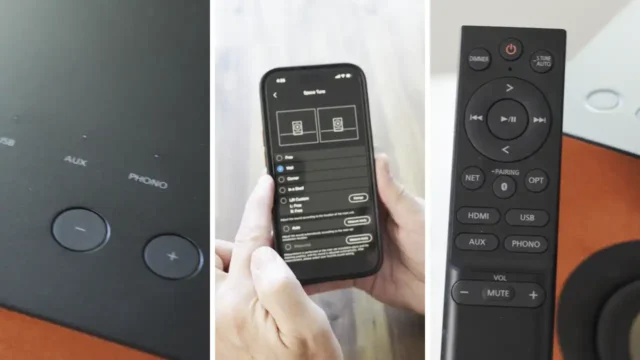
Space Tune works in three modes. You can manually select placement presets (Free, Wall, Corner, or In a Shelf) for each speaker. You can run Space Tune Auto, where the speakers play test tones and use a built-in microphone to analyze your room and optimize settings automatically. Or iOS users can use Measured mode for precise app-based measurements. I used Auto mode, and it works impressively well.
The app also includes bass and treble controls. They’re basic—just two bands—and I wish there was a more comprehensive equalizer at this price point. That said, I haven’t needed to adjust them. Once Space Tune optimizes the speakers for your room, they sound right.
Sound Quality and Performance
The sound of the Technics CX700’s impresses with excellent clarity and detail, particularly in the mid to high range, thanks to it’s up to 41kHz frequency response. They provide strong separation between instruments and a convincing sense of space. The coaxial drivers deliver on their promise of coherent imaging too. You hear subtle elements in recordings that lesser speakers mask or muddy.
This quality extends to TV watching via HDMI. The detail in film soundtracks is remarkable compared to TV speakers or basic soundbars. You hear environmental sounds, and distant background elements, that normally disappear. It’s a substantial upgrade for dialogue clarity and atmospheric sound design.
There’s power here too with each speaker containing it’s own amplification: 60 watts for the woofer and 40 watts for the tweeter. That’s 200 watts total—plenty for most rooms.
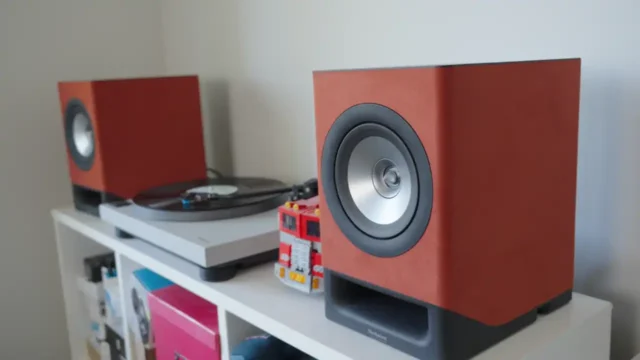
However, there’s an important limitation: these speakers only reach down to 41 Hz. If you want deep, chest-thumping bass for action movies or electronic music, these won’t deliver it alone. That limited low-end extension also means they can struggle to fill larger rooms with authority.
The subwoofer output in the rear of the primary speaker goes some way to address this, but adding a quality subwoofer means additional cost. There’s also no automatic bass management—the main speakers continue playing full-range when a sub is connected, so you’ll need to adjust levels manually.
Summary
The Technics SC-CX700 delivers on its all-in-one promise. You get 200 watts of clean amplification, extensive connectivity, effective room correction, and premium construction in one package. Sound quality is impressive where these speakers are designed to perform: detailed mids and highs with accurate imaging in small to medium rooms.
The bass limitation is real, but Technics acknowledges this with the subwoofer output. If you primarily listen to music genres that don’t emphasize deep bass, such as jazz, acoustic tracks, and vocals, and your room isn’t huge, these work beautifully as a complete system. If you watch action movies or love electronic music, budget for a subwoofer from the start.
These are priced to compete with the KEF LS50 Wireless II (similar sound quality, less connectivity) or excellent passive speakers paired with a quality integrated amp. The SC-CX700’s value proposition is convenience: one system, every source, easy setup, good sound.
Buy these if you value simplicity, want comprehensive connectivity without separate components, appreciate distinctive design, and listen in a small to medium room where their bass capabilities are adequate.
Skip them if you want the deepest possible bass without a subwoofer, prefer building a traditional component system, or need to fill a large space with commanding authority.